The short answer
Blood carries about 0.5 mg of iron per mL. A typical period of 30 to 40 mL costs about 15 to 20 mg of iron, and a heavy one of 80 mL or more costs 40 mg or more. Food puts back 1 to 2 mg a day.
Your period, day by day
A typical period
Food puts back about 1 to 2 mg of iron a day, and everyday losses take about 1 mg. Even on good days that leaves you about 1 mg ahead, so this period takes at least 24 days of iron meals to replace.
An estimate from textbook averages, not a measurement.
| Period | Blood lost | Iron lost |
|---|---|---|
| Light | about 20 mL | about 10 mg |
| Typical | 30–40 mL | 15–20 mg |
| Heavy | 80 mL or more | 40 mg or more |
Why it adds up
Your body recycles almost all of its iron and has no real way to get rid of it. It loses about 1 mg a day through skin, sweat and gut, and food puts back 1 to 2 mg. That leaves little room. A typical period uses up most of a good month's margin, and a heavy one can outrun it. A few heavy months, a pregnancy or a spell of eating less, and stores start to drain.
What counts as heavy
- Soaking a pad or tampon every 1 to 2 hours
- Needing to change at night
- Clots bigger than a coin
- Bleeding for more than 7 days
Heavy bleeding is common, and it is worth showing your doctor. Soaking a pad or tampon every hour for several hours needs a doctor the same day.
This is an estimate from the flow you describe, not a measurement. Pads and cups hold different amounts, so treat the number as a guide to the size of the loss.
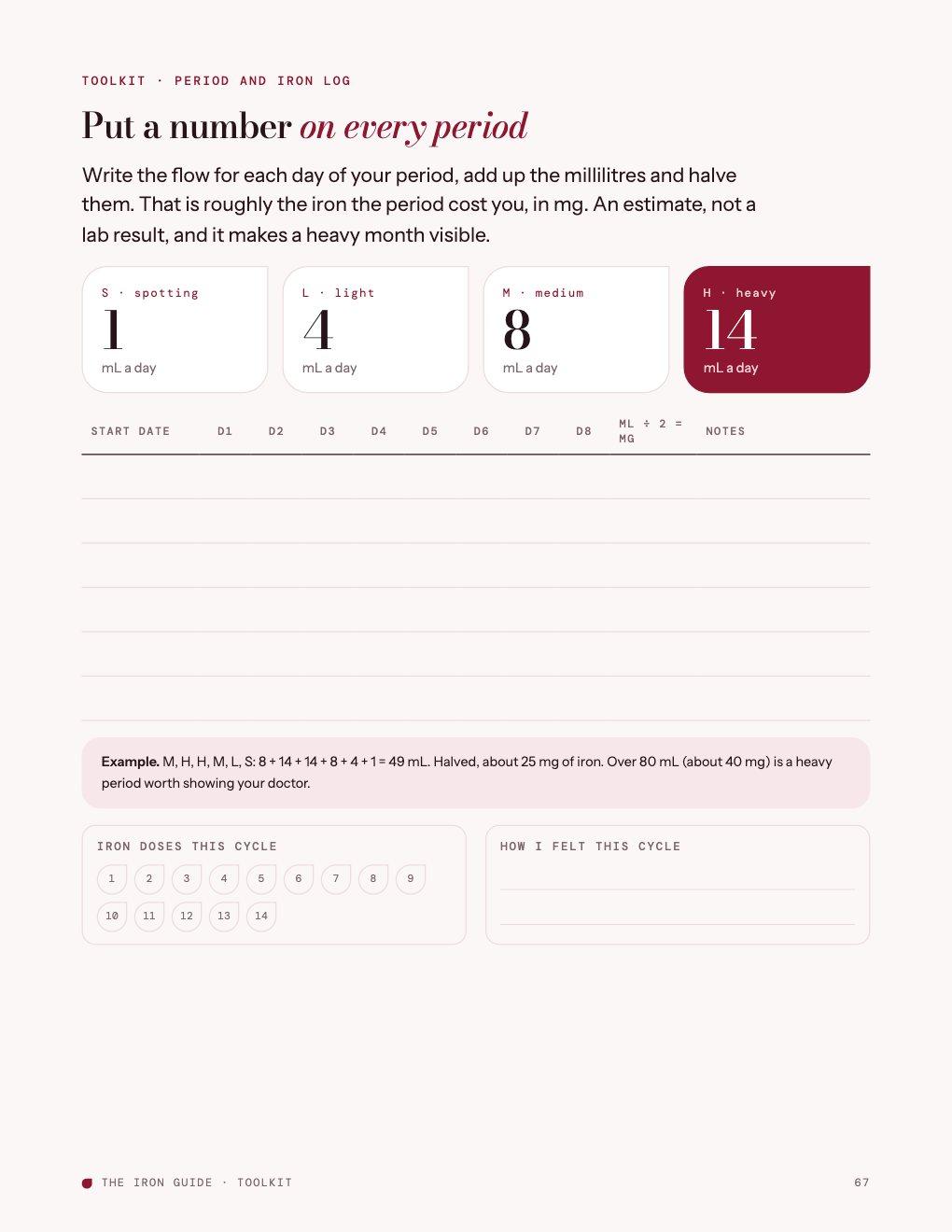 A real page from The Iron GuideThe guide's printable period and iron log.See more pages
Questions
How much blood is in a normal period?
Most estimates put a typical period at 30 to 40 mL, about two to three tablespoons, spread over several days. 80 mL or more is the usual definition of heavy.
Do I need more iron because of my period?
Yes. Women who have periods need about 18 mg of iron a day from food, more than twice the 8 mg a man needs, mainly because of monthly losses.
Sources
- 1.Hallberg L. et al. Menstrual blood loss: a population study. Acta Obstetricia et Gynecologica Scandinavica, 1966
- 2.NICE guideline NG88. Heavy menstrual bleeding: assessment and management
- 3.NIH Office of Dietary Supplements. Iron: fact sheet for health professionals
- 4.The Iron Guide, part 1: Why iron
This page has not been reviewed by a clinician yet. Read it as general education, and take your own results to your doctor.
Educational, not medical advice. ferritin.ai does not diagnose or treat any condition, and it never sets a dose. Talk to your doctor about your own results.